The groom wore dress blues, his white hat set at the perfect angle, the red stripe on his trousers like a ruler. My father, a Marine from the Korean “conflict” five decades ago, said “Semper Fi” as we walked past.
The bride wore a formal wedding gown, all crystal beads and lace, meant for the white runner of a cathedral rather than the well-trod grass of a public park. The wedding party was small, all female. Sisters, mother, friends? They carried her train as she walked down the curving path to the open-air chapel, where an elderly female pastor waited with a Bible, the groom and the young woman who appeared to be his “best man,”
Like the day, this was a time of sunshine and clouds. Laughter fading to thoughtful smiles.
Fifty-some years ago, my father was a young Marine who married in a hurry. My mother’s wedding bouquet was mock orange cut from the bushes in the yard. He was on his way to a war halfway around the world, and there wasn’t time for elaborate wedding plans or engraved invitations.
We caught glimpses of the wedding ceremony from several angles as we meandered through the park. It was always in view, even if we could have forgotten the parallels. My father walks with a heavy limp, the lasting legacy of wounds and imprisonment as a POW. Once a Marine, always a Marine – he spots flags and emblems, is called now to speak to fellow warriors in a reverse of years during which he tried so hard to forget, to go on with life, let the war rest.
This Memorial Day weekend, old wars keep coming into sight. A movie on John McCain’s POW experiences in Vietnam airs this evening on ABC. James Brady has another memoir about the Korean War, The Scariest Place in the World, A Marine Returns to North Korea. (www.amazon.com)
He says that war was necessary, Iraq is not.
Another young Marine only knows that his wedding was a few minutes in a park, because the war never waits.
Monday, May 30, 2005


Wednesday, May 25, 2005


The Underworld Sea
If you were seeking a Martian, you might find it in the spindly creation called an arrow crab.
Sebastien of Grand Case Beach Club Watersports www.snorkel-trips-sxm.com lifted one of the fragile arthropods from the sea floor and set it on my hand. The head and body were as narrow as the legs, a spire or a minaret. When I let it wash free, it drifted down like the frame of an umbrella.
Jack and I are back long enough from St. Martin for the sunscald on my back to heal, but it will be a long, long time before the memories of snorkeling around Creole Rock fade.
My childhood was shaped by regular visits with "The Undersea World of Jacques Cousteau," so the view was familiar when I dipped my mask under the surface. I saw fish I could name - angelfish, damselfish, jacks, parrotfish - and others that later gained a name, the needlefish that swam close to my face. We floated over coral and sea urchins and sea stars, breath rasping in the snorkel tube, fins motivating us forward. We visited the Swimming Pool, where fish swirled around us and the ultra colors of tropical seas were lit by beams of sunlight.
Yet as familiar as it all seemed, from memory, it was an intensely hallucinatory experience. Floating over the sea bottom, with fish pulsing through the uncorrected field of my astigmatic/nearsighted/prebyopteric vision, was like dreaming flight. I moved weightlessly, but the sea slapped at my head. Everything moved in a measured dance, a syrupy present. By the time we had circled the seamount, the combination of rough water and uncertain vision had me queasy - an effect compounded by a faceful of gasoline from a recent boat takeoff. I didn't know you could get seasick while inside the sea, but it is indeed possible.
Poor Sebastien - I know he felt responsible, but it was just that difficult return to Earth from another dimension, an alien underworld of gaudy fliers and improbable creepers.
Can't wait to return ....
Sebastien of Grand Case Beach Club Watersports www.snorkel-trips-sxm.com lifted one of the fragile arthropods from the sea floor and set it on my hand. The head and body were as narrow as the legs, a spire or a minaret. When I let it wash free, it drifted down like the frame of an umbrella.
Jack and I are back long enough from St. Martin for the sunscald on my back to heal, but it will be a long, long time before the memories of snorkeling around Creole Rock fade.
My childhood was shaped by regular visits with "The Undersea World of Jacques Cousteau," so the view was familiar when I dipped my mask under the surface. I saw fish I could name - angelfish, damselfish, jacks, parrotfish - and others that later gained a name, the needlefish that swam close to my face. We floated over coral and sea urchins and sea stars, breath rasping in the snorkel tube, fins motivating us forward. We visited the Swimming Pool, where fish swirled around us and the ultra colors of tropical seas were lit by beams of sunlight.
Yet as familiar as it all seemed, from memory, it was an intensely hallucinatory experience. Floating over the sea bottom, with fish pulsing through the uncorrected field of my astigmatic/nearsighted/prebyopteric vision, was like dreaming flight. I moved weightlessly, but the sea slapped at my head. Everything moved in a measured dance, a syrupy present. By the time we had circled the seamount, the combination of rough water and uncertain vision had me queasy - an effect compounded by a faceful of gasoline from a recent boat takeoff. I didn't know you could get seasick while inside the sea, but it is indeed possible.
Poor Sebastien - I know he felt responsible, but it was just that difficult return to Earth from another dimension, an alien underworld of gaudy fliers and improbable creepers.
Can't wait to return ....
Monday, May 23, 2005
Witness
Not much gets Americans together anymore.
Oh, people come out for festivals or concerts or Super bowl parties, but that’s entirely on the basis of entertainment. Personal utility.
We know that people don’t vote, a public ritual that has little direct utility but a lot of social impact.
This morning, Greensboro came out in a big way for an event that marked a passage for this city and symbolized much that’s going on in our nation today.
They imploded the Burlington Industries headquarters on Friendly Avenue. It was a grand show, with fire sirens, then the measured boom of explosions, fire erupting from the windows, and then a massive fall.
This building, loved or hated as you loved or hated modern architecture, stood for the textile industry in North Carolina, and its demolition was an exclamation point to all the layoffs, downsizings, mergers, factory closings, outsourcings of the past ten years.
An amazing number of people came out to watch the end. Radio stations, TV stations. A newspaper photographer climbed above the crowd to document its size. (see www.news-record.com ) Executives in suits and dark glasses, workers from the Friendly Center in their logo T-shirts, mothers with babies in strollers, elementary school classes. It had some of the atmosphere of a public hanging a century or more ago – a festive atmosphere, though not too much – the radio stations’ pop music seemed intrusive. A sense that we had to be there, to bear witness.
Some people from the old Burlington Industries, wearing caps and shirts with the slogan “Bye-Bye, B.I,” hugged and took pictures of each other.
Then the explosions, the fall, the cloud of dust. People walked away, telling others by cellphone about what they’d seen, about the ash that rained down on their heads as they left.
Oh, people come out for festivals or concerts or Super bowl parties, but that’s entirely on the basis of entertainment. Personal utility.
We know that people don’t vote, a public ritual that has little direct utility but a lot of social impact.
This morning, Greensboro came out in a big way for an event that marked a passage for this city and symbolized much that’s going on in our nation today.
They imploded the Burlington Industries headquarters on Friendly Avenue. It was a grand show, with fire sirens, then the measured boom of explosions, fire erupting from the windows, and then a massive fall.
This building, loved or hated as you loved or hated modern architecture, stood for the textile industry in North Carolina, and its demolition was an exclamation point to all the layoffs, downsizings, mergers, factory closings, outsourcings of the past ten years.
An amazing number of people came out to watch the end. Radio stations, TV stations. A newspaper photographer climbed above the crowd to document its size. (see www.news-record.com ) Executives in suits and dark glasses, workers from the Friendly Center in their logo T-shirts, mothers with babies in strollers, elementary school classes. It had some of the atmosphere of a public hanging a century or more ago – a festive atmosphere, though not too much – the radio stations’ pop music seemed intrusive. A sense that we had to be there, to bear witness.
Some people from the old Burlington Industries, wearing caps and shirts with the slogan “Bye-Bye, B.I,” hugged and took pictures of each other.
Then the explosions, the fall, the cloud of dust. People walked away, telling others by cellphone about what they’d seen, about the ash that rained down on their heads as they left.
Thursday, May 05, 2005
Regalia
It arrived in time - a parcel post box from Salem, Va., with the master's hood I earned way too late in life. It has the royal blue and white of Queen's University, and a band of chestnut brown velvet to indicate the M.F.A.
Regalia seems too much a word for somber academic gowns, despite their satin facings and velvet bands. We've lost the art of adornment that tells a story - the colors and patterns of kimonos, season by season, or the orders and honors of the court. It's all personal now. Those who try to institute new forms of heraldry just seem odd - witness the daily vest-ments of Michael Jackson on his way into the courthouse.
I haven't attended a graduation since my own from the journalism school at West Virginia University. But I have a dozen students or more who have become friends and colleagues in the course of their own journalistic training at A&T, and so on Saturday I'll join the black-robed march to honor them.
Regalia seems too much a word for somber academic gowns, despite their satin facings and velvet bands. We've lost the art of adornment that tells a story - the colors and patterns of kimonos, season by season, or the orders and honors of the court. It's all personal now. Those who try to institute new forms of heraldry just seem odd - witness the daily vest-ments of Michael Jackson on his way into the courthouse.
I haven't attended a graduation since my own from the journalism school at West Virginia University. But I have a dozen students or more who have become friends and colleagues in the course of their own journalistic training at A&T, and so on Saturday I'll join the black-robed march to honor them.
Monday, May 02, 2005
New England in the South
This is the lead of an article that appeared first in The Nashville Tennessean. My parents live in this community, a great little place that like most such places if growing way too fast - visit while you can.
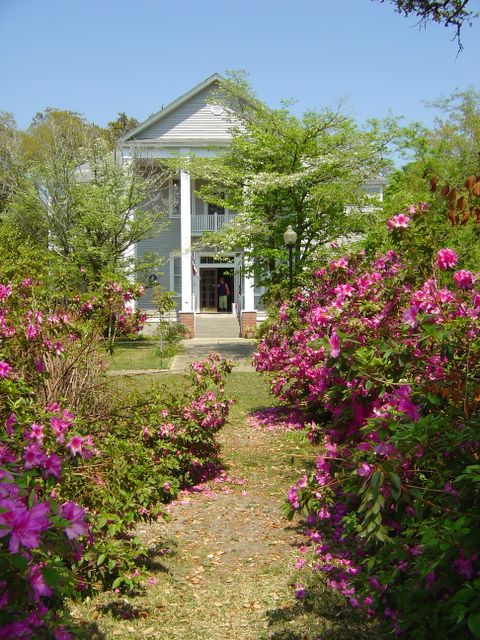
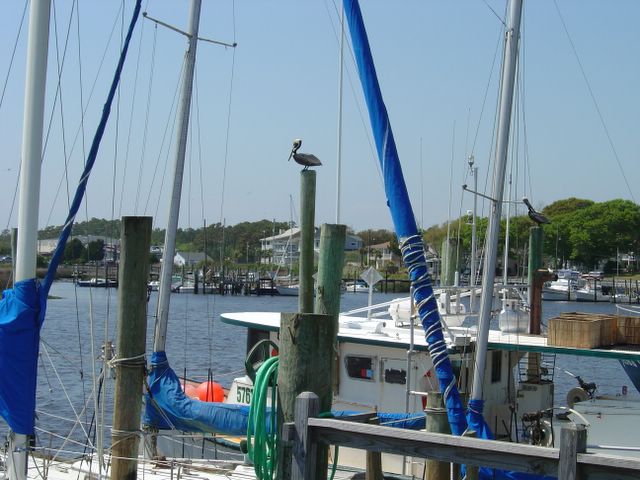
SOUTHPORT, N.C. - American flags snap in the sea breeze at the front of foursquare houses, discreetly marked with plaques naming the captains and merchants who built them two centuries ago. Columned porches offer a view of sailing yachts and fishing boats plying between the harbor and the islands.
But the trees shading those porches are live oaks, and the flag that unfurls its red and blue fields beside the Stars and Stripes is the banner of the Old North State.
Southport, a harbor village at the mouth of the Cape Fear River, has charmed visitors for decades with its New England ambience, and recently has bloomed as a retirement center and arts colony. The location is perfect – 30 miles from the cultural center of Wilmington, 65 miles from the nightlife of Myrtle Beach, S.C. - and only a few miles by water or land from your pick of clean, uncrowded beaches.
The Spanish touched ground here in the 16th century, but settlers didn’t make their mark until the early 1700s. The town of Southport was chartered in 1792 – as Smithville – and began celebrating the nation’s independence each July 4 starting in 1795. Today, it hosts the state’s official Fourth of July Festival, and earns its red-and-white stripes.
“If you ever wanted to see a Fourth of July done Norman Rockwell style, Southport is it,” said Karen Sphar, executive vice president of the Southport Oak Island Chamber of Commerce. “Red, white and blue – you gotta wear it – there’s a lot of patriotic spirit here.”
A naturalization ceremony welcomes new citizens, reminding us of the enduring lure of our democracy. And the city breaks out an old-time parade “with queens and Shriners and people’s dogs from the neighborhood wearing red, white and blue,” Sphar said.
This town likes its festivals – an azalea festival in the spring, fishing tournaments, a Christmas festival featuring a regatta of lighted watercraft, and the annual Art in the Park
On a sunny April afternoon, area artists set up shop in The Grove of Franklin Square Park. Visitors strolled among banks of bright azaleas and bright watercolors, or paused to taste water from the old well that, legend has it, will ensure their return. Penny Prettyman was among the artists gathered at the steps of the Franklin Square Gallery, a former schoolhouse that’s home for a cooperative of some 150 artists. (Monday-Saturday 10 a.m.-5 p.m., Sunday hours June, July and August). She and the other officers chimed in one after the other to promote their gallery, and with good reason – beautiful seascapes and depictions of the town line the walls, but also collage, abstracts, practical and art ceramics and sculpture.
This is the largest but by no means the only gallery. As in New England towns, you will find artists painting the crab traps and pelicans of the fishing fleet, or creating watercolors in Waterfront Park – where you might be entertained by a conga drummer setting a tropical beat.
That park is one of the distinctive features of Southport, with its free municipal fishing pier, whittler’s bench and green-painted porch swings. The ones in the shade of Bay Street oaks are highly regarded by locals and visitors alike.
From the waterfront, walk up Howe Street to enjoy the small-town experience of browsing at local shops, from ones offering smoked seafood or kitchen gadgets or beach fashions to some of the many antique stores. One of more interesting shops is the Dosher Flea Market in a tall red-brick building on Moore Street. This well-run charity operation supports equipment purchases for Dosher Memorial Hospital - a public hospital supported by a tax on local residents.
Howe Street continues as Route 211, past carefully restored cottages that now house professional offices and out to the busy intersection with Long Beach Road that takes you out to Oak Island. Southport is the commercial hub for much of Brunswick County, which extends the full width of the “South Coast” from the mouth of the Cape Fear River to the Little River between the Carolinas. Seaward is string of barrier islands with broad sand beaches and a traditional “summer place” sensibility.
SOUTHPORT, N.C. - American flags snap in the sea breeze at the front of foursquare houses, discreetly marked with plaques naming the captains and merchants who built them two centuries ago. Columned porches offer a view of sailing yachts and fishing boats plying between the harbor and the islands.
But the trees shading those porches are live oaks, and the flag that unfurls its red and blue fields beside the Stars and Stripes is the banner of the Old North State.
Southport, a harbor village at the mouth of the Cape Fear River, has charmed visitors for decades with its New England ambience, and recently has bloomed as a retirement center and arts colony. The location is perfect – 30 miles from the cultural center of Wilmington, 65 miles from the nightlife of Myrtle Beach, S.C. - and only a few miles by water or land from your pick of clean, uncrowded beaches.
The Spanish touched ground here in the 16th century, but settlers didn’t make their mark until the early 1700s. The town of Southport was chartered in 1792 – as Smithville – and began celebrating the nation’s independence each July 4 starting in 1795. Today, it hosts the state’s official Fourth of July Festival, and earns its red-and-white stripes.
“If you ever wanted to see a Fourth of July done Norman Rockwell style, Southport is it,” said Karen Sphar, executive vice president of the Southport Oak Island Chamber of Commerce. “Red, white and blue – you gotta wear it – there’s a lot of patriotic spirit here.”
A naturalization ceremony welcomes new citizens, reminding us of the enduring lure of our democracy. And the city breaks out an old-time parade “with queens and Shriners and people’s dogs from the neighborhood wearing red, white and blue,” Sphar said.
This town likes its festivals – an azalea festival in the spring, fishing tournaments, a Christmas festival featuring a regatta of lighted watercraft, and the annual Art in the Park
On a sunny April afternoon, area artists set up shop in The Grove of Franklin Square Park. Visitors strolled among banks of bright azaleas and bright watercolors, or paused to taste water from the old well that, legend has it, will ensure their return. Penny Prettyman was among the artists gathered at the steps of the Franklin Square Gallery, a former schoolhouse that’s home for a cooperative of some 150 artists. (Monday-Saturday 10 a.m.-5 p.m., Sunday hours June, July and August). She and the other officers chimed in one after the other to promote their gallery, and with good reason – beautiful seascapes and depictions of the town line the walls, but also collage, abstracts, practical and art ceramics and sculpture.
This is the largest but by no means the only gallery. As in New England towns, you will find artists painting the crab traps and pelicans of the fishing fleet, or creating watercolors in Waterfront Park – where you might be entertained by a conga drummer setting a tropical beat.
That park is one of the distinctive features of Southport, with its free municipal fishing pier, whittler’s bench and green-painted porch swings. The ones in the shade of Bay Street oaks are highly regarded by locals and visitors alike.
From the waterfront, walk up Howe Street to enjoy the small-town experience of browsing at local shops, from ones offering smoked seafood or kitchen gadgets or beach fashions to some of the many antique stores. One of more interesting shops is the Dosher Flea Market in a tall red-brick building on Moore Street. This well-run charity operation supports equipment purchases for Dosher Memorial Hospital - a public hospital supported by a tax on local residents.
Howe Street continues as Route 211, past carefully restored cottages that now house professional offices and out to the busy intersection with Long Beach Road that takes you out to Oak Island. Southport is the commercial hub for much of Brunswick County, which extends the full width of the “South Coast” from the mouth of the Cape Fear River to the Little River between the Carolinas. Seaward is string of barrier islands with broad sand beaches and a traditional “summer place” sensibility.
Sunday, May 01, 2005
Vive la Revolution!
I wrote "Welcome to the Revolution" on the board, followed by "Liberte, Egalite, Fraternite."
"You are enmeshed in a revolution," I told my Journalism 220 class, pulling a few more faces up from their forays into the Web. "This is as significant, for you as journalists, as the Reformation and the French Revolution."
I'm not sure they bought my argument, but I believe it.
As the translation of the Bible into common tongues brought received religion before a wider audience ... as the French Revolution reshaped the very language and calendar of a nation and echoed throughout Europe ... the advent of blogging shakes the foundations of standard "objective" journalism and opens the gates to citizen-journalists everywhere.
In the name of impartiality, journalists separated themselves from society. I was taught decades ago that you don't belong to organizations, don't share your religious or political beliefs, avoid as Washington said of nations, "foreign entanglements." But this effort to stand apart from appearances of partiality has ended up making journalists into a sort of priestdom. Like police, reporters tend to play together and stay together - even marry within the ranks.
So now the masses have taken over the means of production, to borrow a phrase from yet another revolution.
I hope that the J-220 students absorbed the concept, if not all the buttressing arguments. Their newsroom lives will be very different from mine. The Web changed journalism, and now blogging and podcasting and technologies just aborning will bring change on change.
It's an exciting time. Information is liberated and liberating. The 'net makes us equals, whether we're typing in a public library or a college office or an elegant mansion. Let's hope that brotherhood is there as well.
"You are enmeshed in a revolution," I told my Journalism 220 class, pulling a few more faces up from their forays into the Web. "This is as significant, for you as journalists, as the Reformation and the French Revolution."
I'm not sure they bought my argument, but I believe it.
As the translation of the Bible into common tongues brought received religion before a wider audience ... as the French Revolution reshaped the very language and calendar of a nation and echoed throughout Europe ... the advent of blogging shakes the foundations of standard "objective" journalism and opens the gates to citizen-journalists everywhere.
In the name of impartiality, journalists separated themselves from society. I was taught decades ago that you don't belong to organizations, don't share your religious or political beliefs, avoid as Washington said of nations, "foreign entanglements." But this effort to stand apart from appearances of partiality has ended up making journalists into a sort of priestdom. Like police, reporters tend to play together and stay together - even marry within the ranks.
So now the masses have taken over the means of production, to borrow a phrase from yet another revolution.
I hope that the J-220 students absorbed the concept, if not all the buttressing arguments. Their newsroom lives will be very different from mine. The Web changed journalism, and now blogging and podcasting and technologies just aborning will bring change on change.
It's an exciting time. Information is liberated and liberating. The 'net makes us equals, whether we're typing in a public library or a college office or an elegant mansion. Let's hope that brotherhood is there as well.
Subscribe to:
Posts (Atom)



 Posts
Posts

